Plastic manufacturers often face challenges such as moisture-related defects, unstable product quality, and high energy costs during material drying. An inefficient drying process can affect production efficiency and increase operational expenses. Dehumidifying dryer solutions help remove moisture from plastic raw materials while maintaining consistent drying conditions.
For plastic processors producing automotive components, medical devices, electronic parts, and packaging products, choosing the right drying equipment is essential. NIASI provides an energy saving dehumidifying dryer designed with a three-machine integrated system, low dew point technology, and compact structure to support reliable plastic material drying applications.
Why Choose NIASI Energy Saving Dehumidifying Dryer?
NIASI specializes in plastic auxiliary equipment, including dehumidifying dryers, gravimetric blenders, hopper loaders, mold temperature controllers, and central feeding systems.
Founded in 2008, NIASI focuses on providing smart solutions for plastic raw material handling. With professional R&D and manufacturing capabilities, the company serves industries including automotive plastics, medical plastics, wire and cable, food packaging, extrusion, and blow molding.
The NIASI energy saving dehumidifying dryer offers several practical advantages:
- Up to 60% energy saving performance compared with traditional drying systems
- Three-machine integrated design for simplified installation and operation
- Compact structure suitable for limited production spaces and dust-free workshops
- No cooling water connection required, making installation easier
- Microcomputer control system for stable operation and simple management
- Dry air volume range from 30-200 m³/hr according to different models
How Does a Plastic Dehumidifying Dryer Work?
A plastic dehumidifying dryer removes moisture from hygroscopic materials such as PET, ABS, PC, nylon, and engineering plastics before processing.
The NIASI system uses low dew point drying technology. The dehumidified air with a dew point reaching -40°C to -50°C is continuously supplied into the drying barrel to absorb moisture from plastic raw materials.
The working process includes:
-
Air dehumidification
The system reduces moisture content in drying air through a dehumidification tower, creating stable low humidity conditions.
-
Dry air circulation
Dehumidified air enters the material barrel and removes moisture from plastic resin particles.
-
Moisture removal and filtration
Water and oil removal filters clean compressed air before it enters the dehumidification system.
-
Continuous material drying
The dried raw materials are ready for injection molding, extrusion, or other plastic processing operations.
This closed drying process helps reduce defects such as bubbles, silver streaks, and poor surface quality caused by excessive moisture.
Energy Saving Dehumidifying Dryer Technical Features
Compared with conventional drying equipment, NIASI focuses on improving energy efficiency and production flexibility.
| Feature | NIASI Energy Saving Dehumidifying Dryer | Traditional Dryer |
|---|---|---|
| Energy Consumption | Up to 60% energy reduction | Higher operating cost |
| Dew Point | -40°C to -50°C | Usually higher moisture level |
| Cooling Water Requirement | No cooling water needed | May require cooling system |
| Installation Space | Compact integrated design | Larger installation area |
| Control System | Microcomputer control | Basic operation control |
| Application | Plastic resin drying, injection molding | General drying applications |
The product series includes models from NFD-15 to NFD-300, with drum capacities from 15kg to 300kg. Air volume options range from 140 m³/hr to 520 m³/hr, allowing manufacturers to select suitable equipment based on production requirements.
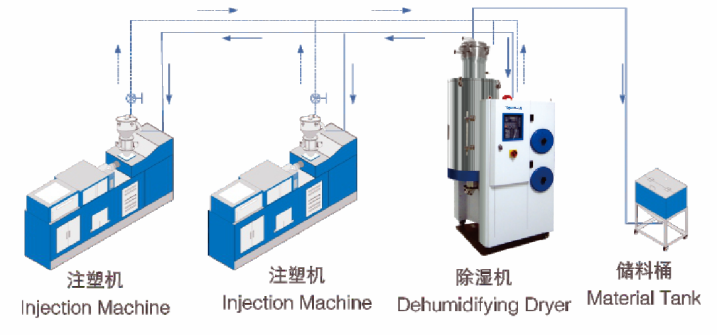
Applications of Industrial Dehumidifying Dryer
A reliable industrial dehumidifying dryer is widely used when moisture control directly affects product quality.
Typical applications include:
Plastic Injection Molding Industry
Injection molding companies use dehumidifying dryers for materials such as PET, ABS, PC, PA, and TPU. Proper drying improves product appearance and reduces material waste.
Medical and Electronic Plastic Production
Medical components and electronic parts require stable processing conditions. Low dew point drying helps maintain consistent material performance.
Automotive Plastic Manufacturing
Automotive manufacturers use resin drying systems for producing precision plastic components with strict quality requirements.
Optical Grade Product Manufacturing
For optical-grade plastic products, NIASI provides customized energy-saving three-machine dehumidification dryer solutions to meet higher drying requirements.
Why NIASI Is a Reliable Dehumidifying Dryer Manufacturer?
When selecting an industrial drying equipment supplier, manufacturers need more than equipment performance. They also need production capability, quality management, and technical support.
NIASI supports customers with:
- Experienced mechanical and electrical engineering teams
- CNC machining, laser cutting, hydraulic pressing, and powder coating production equipment
- Independent product development and manufacturing capability
- Quality inspection processes for stable product performance
- Global distributor and partnership support
NIASI’s manufacturing system enables customized solutions for different plastic processing environments.
How to Select the Right Plastic Dehumidifying Dryer?
Before purchasing a dehumidifying drying machine, you should consider:
- Material type: Different plastics require different drying temperatures and drying times.
- Production capacity: Select suitable drum capacity according to hourly material consumption.
- Required dew point: Sensitive materials may require low dew point drying conditions.
- Installation environment: Compact models are suitable for clean workshops with limited space.
- Energy efficiency: Energy-saving models help reduce long-term operating costs.
Choosing the correct drying system helps improve production stability and reduce unnecessary energy consumption.
FAQ
1. What materials can a dehumidifying dryer process?
A dehumidifying dryer is commonly used for PET, ABS, PC, nylon, TPU, PBT, and other engineering plastic materials that easily absorb moisture.
2. What is the dew point of NIASI dehumidifying dryer?
NIASI dehumidifying dryers provide stable low dew point drying conditions from -40°C to -50°C, suitable for moisture-sensitive plastic applications.
3. Does the NIASI dryer require cooling water?
No. The energy-saving three-machine integrated design does not require cooling water connection, making installation and relocation easier.
Conclusion
Moisture control is a key factor in improving plastic processing quality and reducing production costs. NIASI energy saving dehumidifying dryer provides an efficient solution with low dew point technology, compact design, and stable operation for various plastic manufacturing applications. With professional manufacturing experience since 2008, NIASI continues to support global plastic processors with reliable drying and material handling solutions.
CTA
Contact NIASI today to discuss your plastic drying requirements and get a customized industrial dehumidifying dryer solution based on your material type, production capacity, and application needs.