Plastic production quality heavily depends on moisture control. NIASI’s plastic dehumidifying dryer ensures consistent low dew point drying for PET, PA, PC, and TPU materials, minimizing defects and stabilizing production efficiency.
Why Moisture Control is Critical in Engineering Plastics
Engineering plastics such as PET, PA, PC, and TPU are highly hygroscopic. Even when pellets appear dry on the surface, trapped internal moisture can cause:
- Surface defects, bubbles, or silver streaks in injection molded parts
- Reduced mechanical strength or dimensional instability
- Uneven flow in extrusion lines, leading to inconsistent production
Manufacturers in high-humidity regions or with continuous production often find conventional dryers insufficient. Low dew point drying is essential to maintain material consistency and minimize production defects.
Why Standard Dryers Are Not Enough
Typical hot air or basic drying equipment often:
- Removes only surface moisture
- Cannot stabilize internal molecular moisture
- Fluctuates in performance under high ambient humidity
This creates quality variability in PET resin drying, PA drying solutions, and PC dehumidifying equipment.
NIASI’s low dewpoint dryer solves these issues with stable, precise control and integrated feeding and drying solutions.
Key Features of NIASI’s Plastic Dehumidifying Dryer
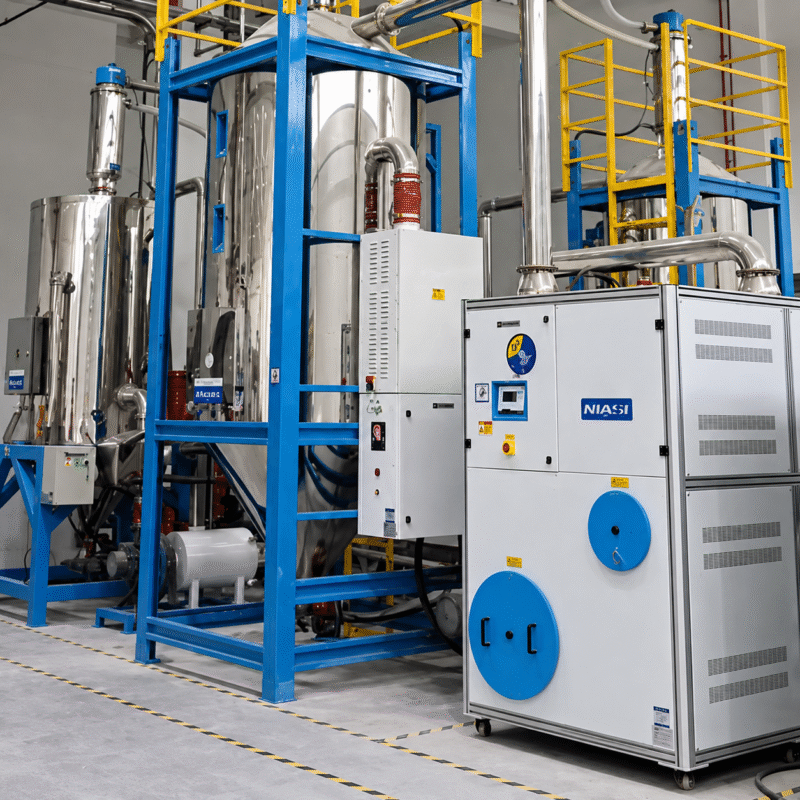
Stable Low Dew Point Control
- Maintains -40°C to -50°C dew point even in high humidity
- Laboratory-tested to perform at 50°C and 85% relative humidity
- Ensures consistent internal and surface dryness for PET, PA, PC, and TPU materials
User-Friendly Digital Interface
- Intuitive control screen for temperature and humidity
- Optimizes drying efficiency and minimizes energy waste
- Reduces manual adjustments and errors
Versatile Across Materials
Compatible with a range of plastics:
- PET resin dryer for transparent packaging and bottle preforms
- PA drying solution for automotive and industrial parts
- PC dehumidifying equipment for optical components and electronic housings
- TPU moisture control dryer for cables, hoses, and seals
Integrated System Approach
- Combines feeding, dehumidification, and drying systems
- Customizable for different workshop layouts and production capacities
- Seamless integration with auxiliary equipment increases overall workflow efficiency
Applications in Plastic Processing
This industrial plastic dehumidifier is ideal for:
- Injection Molding: Prevents warping, bubbles, and surface defects
- Extrusion Lines: Maintains uniform material flow and melt consistency
- Granulation & Recycling: Ensures stable granule quality and moisture control
By using a plastic granule drying system, manufacturers can maintain high output quality, reduce downtime, and improve product consistency.
What to Consider When Choosing a Plastic Dehumidifying Dryer
When evaluating drying equipment, focus on:
- Types of plastic materials processed
- Dew point precision and stability
- Compatibility with central drying systems and feeding solutions
- Laboratory-verified performance under varying humidity
- Ease of operation, monitoring, and maintenance
NIASI provides tailored solutions addressing each factor to ensure reliable performance across production lines.
Advantages Compared to Traditional Dryers
| Feature | NIASI Low Dewpoint Dryer | Traditional Dryers |
|---|---|---|
| Dew Point Range | -40°C to -50°C | -20°C to -30°C |
| Material Compatibility | PET, PA, PC, TPU | Limited plastics |
| Control Interface | Digital, precise | Manual or semi-automatic |
| Performance in Humid Conditions | Stable and consistent | Drops significantly |
| System Integration | Feeding + drying + dehumidification | Standalone systems |
These advantages reduce defects, enhance material quality, and improve operational efficiency.
Maintenance and Support
- Installation: Compact design allows flexible workshop placement
- Monitoring: Digital interface for real-time temperature and humidity
- Maintenance: Routine filter and desiccant checks extend equipment life
- Support: NIASI provides technical guidance and customized solutions
Proper maintenance ensures long-term reliability and consistent performance.
Conclusion
Moisture is one of the most critical factors affecting engineering plastic quality. While conventional dryers may remove surface water, NIASI’s plastic dehumidifying dryer ensures stable low dew point control, precise temperature management, and integrated drying and feeding solutions.
Whether processing PET, PA, PC, or TPU materials, this system helps manufacturers reduce defects, maintain consistent quality, and improve production efficiency.