If you need a Gravimetric Blender for Plastics application that can handle masterbatch, additives, and recycled materials consistently, dosing accuracy is critical. In injection molding and extrusion, unstable material ratios can affect color consistency, product quality, and production efficiency.
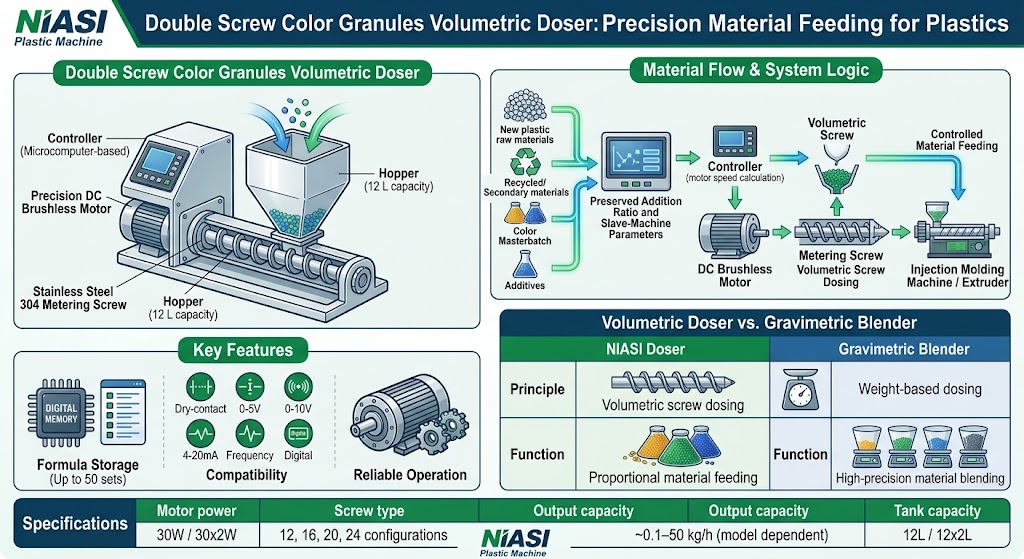
NIASI’s Double Screw Color Granules Volumetric Dosers address this challenge through automatic proportional feeding. The system uses a digital microcomputer controller, precision DC brushless motor, and stainless steel 304 metering screws to deliver controlled material feeding directly to injection molding machines or extruders.
How Does a Gravimetric Blender for Plastics Support Material Dosing?
Although NIASI lists this equipment under its Gravimetric Blender product category, the Double Screw Color Granules Volumetric Doser operates through volumetric screw dosing. This distinction matters when you are selecting equipment for a specific plastic processing line.
The doser is designed to automatically feed:
- New plastic raw materials
- Recycled or secondary materials
- Color masterbatch
- Plastic additives
- Other granular materials used in molding production
The controller converts preset addition ratios and slave-machine parameters into motor speed. The metering screw then delivers the required material at a controlled rate.
This makes the equipment suitable for manufacturers looking for a plastic granule dosing machine that integrates with existing production equipment.
Key Features of NIASI’s Plastic Dosing System
NIASI has designed the system around practical requirements in injection molding and extrusion environments.
Digital Control and Formula Storage
The controller can permanently store up to 50 sets of production data. You can therefore save different material formulations and quickly recall them when switching production conditions.
This feature is particularly useful when you manufacture multiple product colors, materials, or formulations on the same production line.
Multiple Machine Signal Compatibility
The dosing system supports various signals used by plastic processing equipment, including:
- Dry-contact signals for injection molding machines
- 0–5 V
- 0–10 V
- 4–20 mA
- 0–20 mA
- Frequency signals
- Digital signals
This broad compatibility can simplify integration with different injection molding and extrusion machines.
Reliable Screw Feeding
The system uses stainless steel 304 precision metering screws driven by DC brushless motors. The brushless motor design requires less routine maintenance, while protection functions help safeguard continuous operation.
You can also choose a material-level detection sensor to receive an alarm when material levels become insufficient.
Double Screw Color Granule Doser Specifications
The product family includes single-color and multi-color configurations. Depending on your production requirements, NIASI offers two-color, three-color, and four-color dosing solutions.
| Specification | Available Range / Configuration |
|---|---|
| Motor power | 30 W / 30 × 2 W |
| Motor speed | 3,000 rpm |
| Stirring power | 90 W |
| Screw type | 12, 16, 20, 24 and other configurations |
| Output capacity | Approximately 0.1–50 kg/h depending on model |
| Tank capacity | 12 L / 12 × 2 L |
| Reduction ratio | 30, 50, 30/30, 30/50, 50/50 |
| Height | 520–615 mm |
| Width | 610–1,045 mm |
| Weight | 15–33 kg |
For example, the CM30-24 model has an output capacity of 1.8–50 kg/h, while the CM50-12 model provides approximately 0.1–2.2 kg/h. You can therefore select the screw and model according to your required dosing range.
How to Integrate a Plastic Granule Dosing Machine
When selecting a precision feeding system, you should evaluate both the material and the production equipment.
Step 1: Identify Your Materials
Determine whether you are feeding virgin resin, recycled material, masterbatch, or additives. Particle size, flow characteristics, and formulation requirements can influence screw selection.
Step 2: Define the Required Dosing Ratio
Set the required addition ratio according to your production formulation. This helps the controller calculate the corresponding feeding speed.
Step 3: Confirm Machine Signals
Check the available signal interface on your injection molding machine or extruder. NIASI supports multiple signal types, making integration more flexible.
Step 4: Select the Dosing Configuration
Choose a single-color or multi-color configuration based on the number of materials that must be dosed simultaneously.
Step 5: Configure Optional Functions
You can add material-level detection and a mixing base when your application requires automatic low-material alerts or improved material uniformity.
Gravimetric Blender for Plastics vs. Volumetric Doser
The terminology can create confusion when researching plastic processing equipment. A true gravimetric blender normally controls material based on weight measurement, while this NIASI product uses precision screw-based volumetric dosing.
| Factor | NIASI Volumetric Doser | Gravimetric Blender |
|---|---|---|
| Feeding principle | Volumetric screw dosing | Weight-based dosing |
| Main function | Proportional material feeding | Gravimetric blending |
| Typical materials | Granules, masterbatch, additives | Multiple plastic materials |
| Control | Digital microcomputer | Weight feedback control |
| Best suited for | Injection molding and extrusion dosing | High-precision material blending |
| Configuration | Single or multi-color dosing | Multi-component blending |
Therefore, if your primary requirement is masterbatch dosing, color addition, or proportional feeding, the volumetric doser configuration may be more appropriate than choosing equipment solely by the term “gravimetric blender.”
Why Choose NIASI for Plastic Processing Equipment?
Founded in 2008, Dongguan NIASI Plastic Machine Co., Ltd. focuses on material conveying systems and auxiliary equipment for the plastics industry.
NIASI operates its own R&D and manufacturing capabilities, covering:
- Mechanical structure design
- Electrical automation engineering
- Hardware and software development
- Product testing and quality inspection
- CNC machining and sheet-metal processing
- Powder coating and manufacturing processes
The company serves plastic processing applications including automotive components, medical devices, wire and cable, food packaging, plastic pipes, extrusion blow molding, and granulation.
NIASI also maintains product certification and testing documentation as part of its quality management and manufacturing process. For your specific project, you should request the applicable certificates and technical documents before purchasing.
FAQ
Is this machine suitable for injection molding?
Yes. The doser is designed for proportional feeding into injection molding machines and supports dry-contact and various electrical signal inputs.
Can it dose color masterbatch?
Yes. The system is specifically designed for automatic proportional feeding of masterbatch, additives, virgin materials, and secondary materials.
What is the maximum output?
Depending on the selected model and screw configuration, the listed output range reaches approximately 50 kg/h. The CM30-24, for example, is specified at 1.8–50 kg/h.
Conclusion
If you need a Gravimetric Blender for Plastics solution for proportional material feeding, NIASI’s Double Screw Color Granules Volumetric Doser provides a practical option for injection molding and extrusion applications. With 30 W DC brushless motors, stainless steel 304 metering screws, storage for 50 production data sets, multiple signal interfaces, and output capacities ranging from approximately 0.1 to 50 kg/h depending on model, you can configure the system around your production requirements.
Contact NIASI with your material type, required dosing ratio, target output, and injection molding or extrusion machine signal to determine the appropriate doser configuration for your application.