A Water type mold temperature controller helps you maintain stable mold temperatures when inconsistent heating or cooling causes warping, cycle variation, surface defects, or wasted energy. In plastic injection molding, you need more than a heater: you need controlled heat transfer, rapid temperature response, and reliable protection for continuous production.
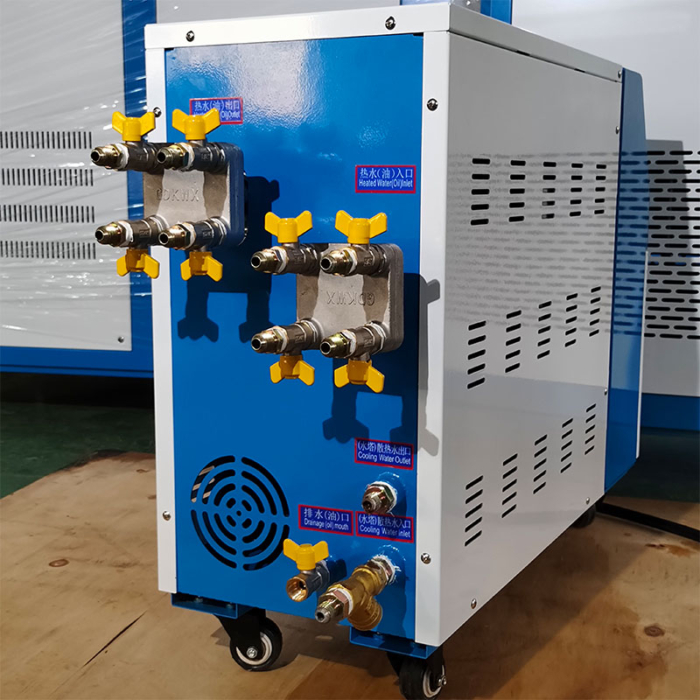
NIASI’s water mold temperature controller uses water as the heat transfer medium and supports direct cooling for standard applications or indirect cooling for high-temperature applications. Depending on the configuration, the system provides temperature control from 120°C to 160°C for standard models, while high-temperature models can reach up to 180°C.
Why Use a Water Type Mold Temperature Controller?
Water transfers heat efficiently and remains readily available in many industrial production environments. As a result, a water-based system can provide practical operating costs while supporting stable mold temperature control.
For injection molding manufacturers, stable temperature control can directly affect product consistency and production efficiency. NIASI designs its systems specifically for plastic molding applications, including automotive components, medical devices, packaging, wire and cable, and plastic pipe production.
Key advantages include:
- ±0.1°C temperature control accuracy for precise molding conditions
- Water as the heat transfer medium
- Rapid heating and cooling response
- Specialized PID temperature control
- More than 35% energy savings claimed for the PID control design
- 304 stainless steel integrated main pipeline
- Automatic air exhaust during startup
- Fault indication and comprehensive safety protection
- Models with 6 kW to 24 kW heater power
- AC 380V/3P/50Hz power supply
Water Mold Temperature Controller for Injection Molding
When you use an injection molding temperature control system, the controller must respond quickly when the mold temperature changes. A slow response can increase cycle fluctuations and make it harder to maintain consistent plastic part quality.
NIASI combines a specialized PID controller with a dedicated heating design. The controller continuously adjusts the heating process, while the water circulation system transfers heat through the mold circuit.
PID Temperature Control and ±0.1°C Accuracy
The PID system helps you maintain a more stable target temperature rather than relying on simple on/off heating. NIASI specifies temperature control accuracy of up to ±0.1°C, which can help you maintain repeatable molding conditions.
The system also separates key components from the main body to improve thermal insulation. This design helps protect electrical components from excessive heat and supports longer component service life.
Standard vs High-Temperature Water Mold Temperature Controller
Different plastic molding processes require different temperature ranges. You can select the appropriate system according to your mold temperature requirements and cooling configuration.
| Feature | Standard Water Type | High-Temperature Water Type |
|---|---|---|
| Heat transfer medium | Water | Water |
| Cooling method | Direct cooling | Indirect cooling |
| Temperature range | Up to 120–160°C depending on configuration | Up to 180°C |
| Heater power | 6–24 kW | 6–24 kW × 2 configurations |
| Temperature accuracy | ±0.1°C | ±0.1°C |
| Typical application | General plastic molding | Higher-temperature molding processes |
| Control | PID | PID |
Before purchasing, you should confirm the required mold temperature, heater capacity, pump flow, cooling water conditions, and electrical configuration.
How to Select an Industrial Mold Temperature Controller
You can use the following steps to match the controller to your process:
- Define the required temperature range. Determine whether your process needs standard water temperature control or operation approaching 180°C.
- Calculate heating requirements. NIASI offers models with 6, 9, 12, and 24 kW heater configurations.
- Check circulation requirements. Available pump flow ranges from 35 to 70 L/min across the listed models.
- Confirm cooling conditions. The specified water pressure requirement is 2.5 kg/cm², with PT1/2 cooling water piping.
- Check electrical requirements. The listed systems use AC 380V/3P/50Hz.
- Match the controller to your production environment. Consider mold size, cycle time, material, operating temperature, and available cooling water.
NIASI Water Type Mold Temperature Controller Applications
NIASI has focused on plastic processing equipment since 2008 and manufactures equipment for material conveying, drying, blending, cooling, temperature control, and other plastic processing operations.
You can apply this water type mold temperature controller in production environments such as:
- Automotive plastic components
- Medical device molding
- Food and packaging products
- Wire and cable production
- Plastic pipe manufacturing
- Injection molding applications
- Other industrial plastic processing operations
NIASI operates its own R&D and manufacturing capabilities, including CNC machining, laser cutting, hydraulic pressing, powder coating, and product testing equipment. The company also provides a dedicated certification section, allowing customers to review its available certification documentation when evaluating supplier qualifications.
FAQ
What is a water type mold temperature controller?
A water type mold temperature controller uses water as the heat transfer medium to heat and cool a mold circuit. It helps maintain a controlled mold temperature during plastic processing.
How accurate is the NIASI water mold temperature controller?
NIASI specifies temperature control accuracy of up to ±0.1°C. Actual process performance depends on the mold, piping configuration, cooling conditions, and operating environment.
Can a water mold temperature controller reach 180°C?
Yes. NIASI offers high-temperature configurations that can reach up to 180°C through an indirect cooling design. You should confirm the required temperature range and model configuration before ordering.
Conclusion
Choosing a Water type mold temperature controller gives you a practical way to manage heating and cooling during plastic molding. With ±0.1°C control accuracy, PID regulation, 6–24 kW heater options, water circulation, and configurations reaching up to 180°C, NIASI provides temperature control equipment for different industrial molding requirements.
CTA
If you are selecting a mold temperature controller for a new injection molding line or replacing an existing unit, contact Dongguan NIASI Plastic Machine Provide your mold temperature range, required heater power, mold application, cooling water conditions, and power supply. NIASI can then help you identify a suitable water temperature control configuration for your production process.